

Contents
- Why stage inventory at the border instead of deep in Mexico?
- What does a Laredo warehouse do?
- What does a Monterrey warehouse do?
- How do the two warehouses work together?
- What fulfillment services should you expect?
- How does border staging speed up delivery?
- How does this support Amazon FBA and marketplace sellers?
- How do you choose a border fulfillment partner?
- Laredo and Monterrey: roles in a border corridor (2026)
- Definitions
- Frequently asked questions
- Why stage inventory at the border?
- What does a Laredo warehouse do?
- What does a Monterrey warehouse do?
- How do the two warehouses work together?
- What services should a border fulfillment partner offer?
- How does border staging speed up delivery?
- Does this work for Amazon FBA sellers?
- How do I choose a border fulfillment partner?
- Related Reading
- Sources
Border warehousing means staging your inventory right at the US and Mexico line, with a Laredo warehouse on the US side and a Monterrey warehouse on the Mexican side. You consolidate and prepare goods in Laredo, cross them once, and fulfill Mexican orders from Monterrey. This shortens delivery, groups shipments into efficient customs crossings, and keeps stock close to the border for both markets.
Laredo is North America's busiest inland port, with more than 17,000 trucks crossing per day (City of Laredo, 2026).
A Laredo warehouse handles US receiving, consolidation, and export prep; a Monterrey warehouse handles Mexican fulfillment and returns.
Crossing consolidated loads once, rather than many small parcels, lowers the customs cost per unit.
A well documented full truckload reaches Monterrey from Laredo in 1 to 2 business days (BringGo Ship operations data).
Border staging keeps inventory close to both markets, so goods can serve US and Mexican demand from one corridor.
Why stage inventory at the border instead of deep in Mexico?
Staging at the border keeps your goods close to both markets and to the crossing itself, so you cross efficiently, deliver into Mexico quickly, and keep the option to serve US demand, without committing all your stock to one interior location.
Staging inventory at the border is about keeping options open while staying close to demand. If you push all your stock deep into interior Mexico, every US need means an expensive move back, and every restock means a long domestic haul. If you keep it all in the US, every Mexican order is a fresh cross-border trip. The border solves both by putting inventory where it can go either way with the shortest possible move. Laredo, on the US side, is the busiest inland port in North America, so it is where consolidation and crossing are fastest and cheapest. Monterrey, a few hours south, is close enough to serve Mexican customers quickly yet still near the border for restocking and returns. Holding stock across this short corridor means you cross in efficient, consolidated loads, deliver into Mexico in one to two days, and keep the flexibility to feed US channels too. For a business selling into both markets, the border is simply the most efficient place for inventory to wait.
What does a Laredo warehouse do?
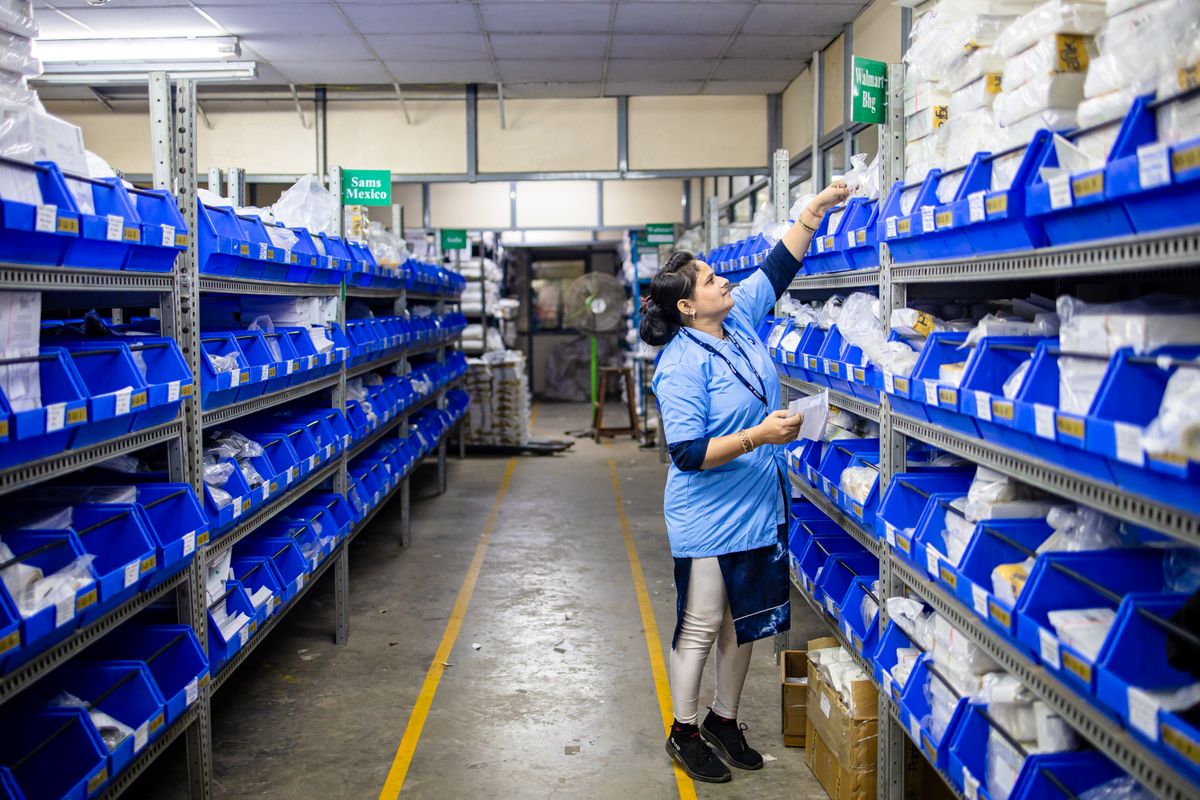
A Laredo warehouse is your US side hub: it receives inbound US inventory, stores it, consolidates orders, prepares export paperwork, and stages loads to cross the border efficiently, often with FBA prep and labeling too.
The Laredo warehouse is where the US side of the operation happens, and its job is to make every crossing clean and efficient. It receives your inbound inventory from US suppliers or your own facilities, stores it, and consolidates smaller shipments into fuller loads so you cross once instead of many times. It is where export formalities are prepared and where documents are checked before anything moves, which is the single biggest lever for avoiding customs delays. Many border warehouses also do value added work here: labeling, kitting, and Amazon FBA prep, so goods are shipment ready before they cross. Because Laredo is the busiest inland port in North America, with more than 17,000 trucks crossing daily, the infrastructure and carrier availability are strong, which keeps crossing fast. In practice, the Laredo side is where you turn a stream of inbound stock into well documented, consolidated, crossing ready loads. Get this side right and the Mexican side runs smoothly, because most border problems are really document problems that should have been caught in Laredo.
What does a Monterrey warehouse do?
A Monterrey warehouse is your Mexican side hub: it receives cleared inventory, stores it in market, picks and packs Mexican orders for fast local delivery, and handles returns, so your business has a real presence inside Mexico.
The Monterrey warehouse is the Mexican side of the corridor, and it is what gives your business a genuine in country presence. Once goods have cleared customs, they arrive here and are stored in market, ready to serve Mexican demand without any further border crossing. From Monterrey, orders are picked, packed, and shipped domestically, which means fast local delivery times and local shipping costs rather than international ones. It is also your returns hub: Mexican customers return to a local address, and the warehouse inspects, restocks, or batches those returns. Monterrey is well chosen for this because it sits in Nuevo Leon, a major industrial center at the heart of the nearshoring wave, just a few hours from the border and the Laredo crossing. That proximity means restocking from the US side is quick, so the Monterrey warehouse can run lean and replenish often. Together with Laredo, it lets you operate as if you were a domestic Mexican seller on the front end, while your inventory and crossings are managed on the back end.
How do the two warehouses work together?
Laredo consolidates and prepares, the goods cross once, and Monterrey fulfills. Restocking, returns, and any US bound goods flow back the other way, so the two sites act as one operation spanning the border.
The power of the model is that the two warehouses act as a single operation with the border in the middle. Inbound US stock arrives in Laredo, where it is consolidated, prepared, and documented. It crosses the border once, as an efficient load, and clears customs. On the Mexican side it lands in Monterrey, where it is stored and used to fulfill Mexican orders quickly. The flow is not only one way: returns come back into Monterrey and are restocked or batched, and any inventory needed for US channels moves back north from the corridor. Because the two sites are only a few hours apart, moving stock between them is fast and cheap, so you can keep Monterrey lean and replenish it frequently from Laredo rather than overstocking the Mexican side. This rhythm, consolidate in Laredo, cross once, fulfill from Monterrey, restock as needed, is what turns two warehouses into a corridor. A single operator running both, like BringGo Ship, coordinates the crossing and the customs in between, so you deal with one partner instead of stitching together a US warehouse and a Mexican warehouse yourself.

What fulfillment services should you expect?
Expect receiving, storage, pick and pack, kitting and labeling, Amazon FBA prep, customs coordination, domestic delivery in Mexico, and returns handling, delivered as one connected service across both sides of the border.
A border fulfillment partner should cover the whole chain, not just storage. On the US side, expect inbound receiving, inventory storage, order consolidation, and export preparation, plus value added services like kitting, labeling, and Amazon FBA prep so goods are ready before they cross. In the middle, expect customs coordination, so the crossing and the paperwork are handled for you rather than left as your problem. On the Mexican side, expect storage in market, pick and pack for individual orders, domestic delivery across Mexico, and a returns process that receives, inspects, and restocks locally. The point of listing these is that they should feel like one service, not a set of vendors you coordinate. When receiving, crossing, fulfillment, and returns are run by one operator across both warehouses, you get a single point of contact, one set of inventory numbers, and consistent handling. That integration is the real product; the individual services are common, but having them stitched into one corridor with the customs handled in between is what saves you time and cost.
How does border staging speed up delivery?
Because the stock is already in Mexico after one planned crossing, Mexican orders ship domestically from Monterrey instead of crossing the border per order, cutting days off delivery and removing per order customs.
Border staging speeds up delivery by moving the customs step out of the individual order. If you fulfill each Mexican order from the US, every single order has to cross the border and clear customs, which adds days and cost to each one. When you stage inventory in Monterrey, that crossing has already happened once, in bulk, ahead of demand, so an incoming Mexican order simply ships domestically from local stock the same way a Mexican seller would ship it. The customer gets local delivery times, and you avoid a per order clearance entirely. The Laredo to Monterrey leg that put the stock in place is itself fast, typically one to two business days for a well documented full truckload, so replenishment keeps pace with sales. The net effect is that the slow, variable part of cross-border, the customs crossing, is done in planned bulk moves rather than on the critical path of every customer order. That is the core reason border staging feels fast to the end customer even though the goods originated abroad.
How does this support Amazon FBA and marketplace sellers?
The Laredo side can do FBA prep and labeling before crossing, and the corridor delivers bulk inventory into Amazon Mexico's fulfillment centers or your own Monterrey stock for Mercado Libre and direct sales.
For marketplace sellers, border warehousing is often the missing piece between US inventory and a Mexican storefront. If you sell on Amazon Mexico with FBA, your inventory has to arrive at Amazon's Mexican fulfillment centers prepped to their standards; the Laredo warehouse can do the FBA prep and labeling before the goods cross, and the corridor delivers the bulk shipment into the Amazon network, cleared and compliant, within their receiving windows. If you use remote fulfillment from US stock, the Laredo side supports that flow too. For Mercado Libre or your own direct sales, the Monterrey warehouse holds local stock and fulfills domestically, which is what those channels expect. The common thread is that the corridor adapts to whichever channel you use while handling the part every channel shares: getting inventory across the border, cleared, and into position. A seller can therefore run Amazon Mexico, Mercado Libre, and a direct store from the same staged inventory, with the border logistics handled once rather than solved separately for each channel.
How do you choose a border fulfillment partner?
Look for warehouses on both sides of the border, a complete customs file before the crossing, real experience on the Laredo to Monterrey lane, marketplace prep capability, and transparent inventory reporting across both sites.
Choosing a partner comes down to whether they can genuinely run the whole corridor as one operation. The first thing to check is physical: do they have warehouses on both sides of the border, in Laredo and in Monterrey, or are they really a US warehouse promising a Mexican handoff? The second is customs: do they coordinate clearance with a licensed Mexican customs broker before the crossing? The third is lane experience: do they actually run Laredo to Monterrey regularly, with real transit data, or is it a route they subcontract? The fourth is capability: can they do the value added work you need, like FBA prep, labeling, and returns handling? The fifth is visibility: will you see one consistent set of inventory numbers across both sites, or two disconnected systems? A partner that answers these well, as BringGo Ship does with its Laredo and Monterrey warehouses, lets you treat the border as solved infrastructure. One that falls short on any of them tends to push the hard parts, customs and the crossing, back onto you at the worst moment.
Laredo and Monterrey: roles in a border corridor (2026)
Function | Laredo (US side) | Monterrey (Mexico side) |
Primary role | Receiving, consolidation, export prep | Fulfillment, storage in market, returns |
Customs | Prepare documents, stage the crossing | Receive cleared goods |
Value added | FBA prep, kitting, labeling | Pick and pack, local delivery |
Delivery served | Feeds the crossing and US channels | Domestic Mexican orders |
Returns | Batches bound for the US | Local return address and restock |
Definitions
Border staging: Border staging is holding inventory near the US and Mexico line so it can cross efficiently and serve both markets quickly.
Consolidation: Consolidation is combining smaller shipments into fuller loads so they cross the border in one efficient movement.
FBA prep: FBA prep is the labeling and packaging work that makes inventory ready to be received by Amazon's fulfillment centers.
Fulfillment center: A fulfillment center is a warehouse that stores inventory and picks, packs, and ships individual customer orders.
Frequently asked questions
Why stage inventory at the border?
Because it keeps your goods close to both markets and to the crossing itself. You consolidate and cross efficiently, deliver into Mexico in one to two days from Monterrey, and keep the flexibility to serve US demand, instead of committing all your stock deep in interior Mexico or leaving it in the US.
What does a Laredo warehouse do?
It is the US side hub: it receives inbound inventory, stores it, consolidates orders, prepares export documents, and stages loads to cross efficiently. Many also do FBA prep, kitting, and labeling, so goods are shipment ready before they cross. Laredo is North America's busiest inland port.
What does a Monterrey warehouse do?
It is the Mexican side hub: it receives cleared inventory, stores it in market, picks and packs Mexican orders for fast local delivery, and handles returns. It gives your business a real in country presence, so Mexican customers get local delivery and a local return address.
How do the two warehouses work together?
Laredo consolidates and prepares, the goods cross the border once, and Monterrey fulfills Mexican orders. Returns and US bound stock flow back north. Because the sites are a few hours apart, you can keep Monterrey lean and restock it often from Laredo, running both as one operation.
What services should a border fulfillment partner offer?
Receiving, storage, pick and pack, kitting and labeling, Amazon FBA prep, customs coordination, domestic delivery in Mexico, and returns handling, all delivered as one connected service across both sides of the border rather than as separate vendors you coordinate.
How does border staging speed up delivery?
Because the stock is already in Mexico after one planned bulk crossing, each Mexican order ships domestically from Monterrey instead of crossing the border individually. That removes a per order customs clearance and cuts days off delivery, so the customer gets local delivery times.
Does this work for Amazon FBA sellers?
Yes. The Laredo side can do FBA prep and labeling before crossing, and the corridor delivers bulk inventory into Amazon Mexico's fulfillment centers, cleared and within their receiving windows. The same staged inventory can also feed Mercado Libre and your own direct sales from Monterrey.
How do I choose a border fulfillment partner?
Look for real warehouses on both sides of the border, clearance coordinated before the crossing, genuine Laredo to Monterrey lane experience, marketplace prep capability, and one transparent set of inventory numbers across both sites. BringGo Ship runs this full corridor.
Related Reading
Create a free account and stage your inventory across the border with BringGo Ship
Sources
City of Laredo (World Trade Bridge data) (cityoflaredo.com)
US Department of Commerce, Mexico logistics (trade.gov)
SAT (Mexico tax and customs authority) (sat.gob.mx)
Note: This content is for general information only and is not legal, tax or customs advice. Rates and rules can change often in 2026; verify the current details with an official source (SAT, DOF, CBP) or a licensed customs broker before acting.
How this was made: The BringGo Ship team chose the topic and the sources. The text was drafted with AI assistance, its figures and regulatory details were checked against official sources (DOF, SAT, ANAM, CBP), and the article was reviewed by our team before publication.
Daniel Brooks
Logistics and Customs Lead
Covers US Mexico cross-border logistics and customs at BringGo Ship, with warehouses in Laredo and Monterrey.
View profile